

Slovenia's Supervisory Board Association Challenges Draft National Demographic Fund Law
An overhaul of how Slovenia manages state-owned assets meant to shore up its pension system has drawn sharp criticism from the country's corporate governance watchdog. The Slovenian Supervisory Board Association (ZNS) has condemned the draft law establishing a National Demographic Fund, arguing it dismantles key safeguards and opens the door to direct political meddling in the appointment of leadership and oversight bodies.
In a formal submission to the public consultation, which runs until 5 August, the ZNS said the current text abandons several mechanisms that currently keep the management of state holdings at arm's length from day-to-day politics. They point specifically to the government gaining a direct majority on the fund's supervisory board, the scrapping of a mandatory professional commission for nominating candidates, and the lowering of experience requirements for board members from ten to five years.
The association – whose executive director is Irena Prijović – also highlights the removal of an explicit ban on candidates who have held a political party function in the past six months, the elimination of a requirement for a certificate of knowledge of supervisory board duties, and the dropping of a rule that prevented anyone found by the Anti-Corruption Commission (KPK) to have violated integrity rules from serving on the board.
Further, the draft law does away with the mandatory compliance and integrity officer, abandons rules on inside information, conflict of interest reporting, and related-party transactions, and reduces transparency obligations compared to the existing SDH Act. The ZNS warns that the proposed legislation effectively allows a complete personnel reset – including the immediate removal of current supervisory board members – during the sensitive period when assets are being transferred and consolidated into the new fund. The Ministry of Finance has said it will study the comments and refine the draft, but the ZNS has already aligned itself with the KPK's earlier warning that the fund's governance model is inadequate.
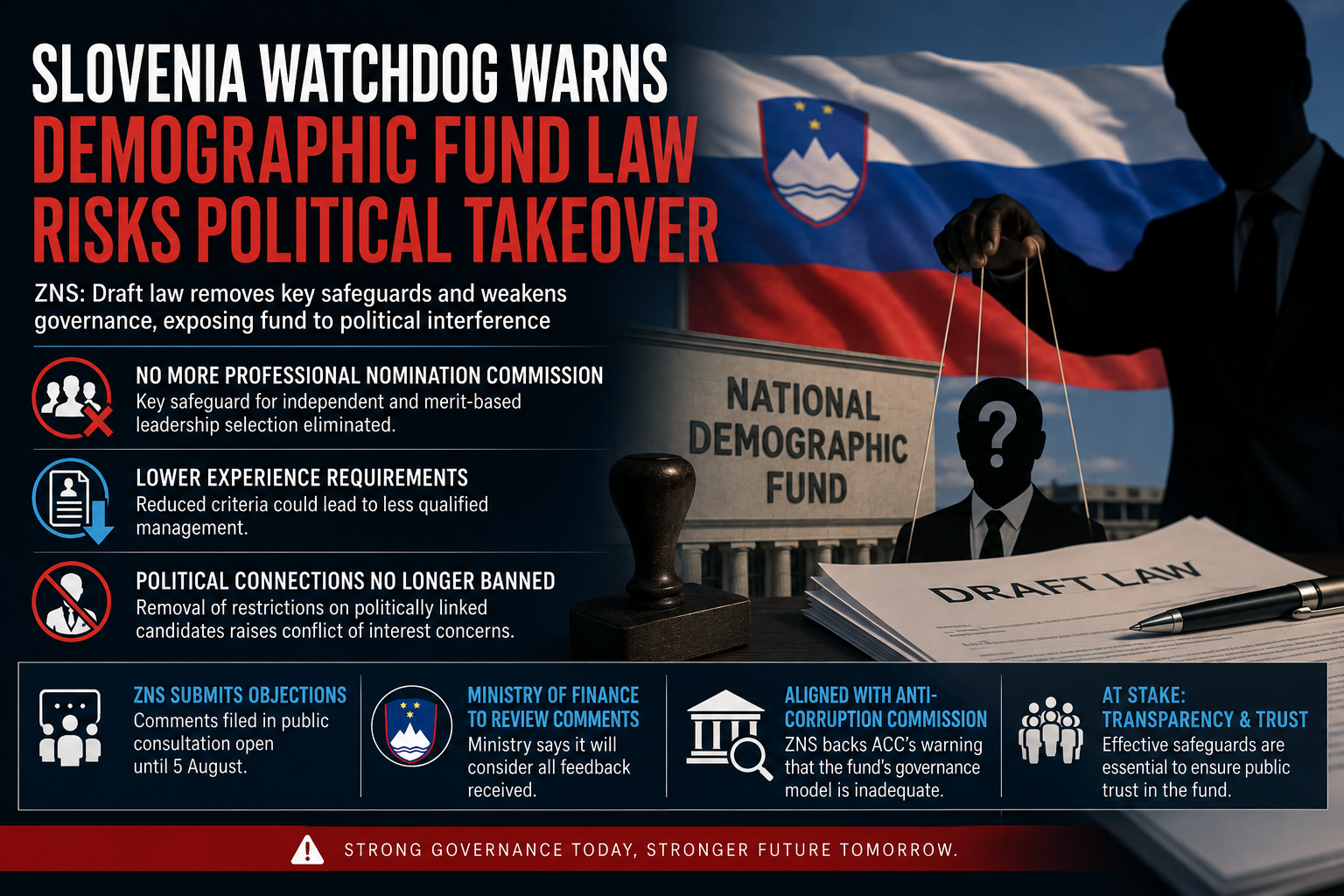
Why Governance Watchdogs See Red Flags in the Fund's Design
The Battle Over Independence from Political Influence
The heart of the dispute is who gets to decide how Slovenia's largest state-owned asset pool – eventually the demographic fund – is run. Under the current SDH Act, a professional commission screens and ranks candidates for the supervisory board. Any departure from its recommendation must be publicly disclosed and justified. The new draft eliminates that commission and gives the government a built-in majority on the board, effectively letting the executive branch pick the overseers of the fund without any forced transparency. The ZNS sees this as a direct reversal of years of effort to insulate state assets from short-term political cycles.
Why Lowered Qualification Standards Matter
Reducing the mandatory professional experience from ten years to five may seem like a technical tweak, but in context it signals a willingness to bring in individuals less bound by long careers in professional asset management or governance. Combined with the removal of the “no recent political party function” rule, the changes could allow politically connected individuals who lack deep financial markets experience to sit on the board. The ZNS instead pushes for a “fit and proper” framework modelled on those used for systemically important financial institutions – where suitability is continuously assessed, not just checked at the moment of appointment.
Compliance and Integrity Gaps
Perhaps the most startling omission in the draft is the absence of a dedicated compliance and integrity function. The current SDH structure has a mandatory “compliance and integrity officer” and explicit rules on handling inside information, anonymous reporting of unethical conduct, conflicts of interest, and gifts. Replacing these with a generic reference to existing integrity legislation leaves the fund without the internal architecture to detect and prevent mismanagement. For a vehicle that will concentrate enormous assets transferred from the state, the ZNS argues that reliance on external, general-purpose anti-corruption laws is insufficient.
Who Gains and Who Loses From the Current Draft
If the law passes as written, the direct beneficiaries are the political actors in government who would control supervisory appointments and, through the ability to appoint a temporary management board, could shape the fund’s strategy immediately. The losers are the professional supervisory board members currently in place, whose mandates would terminate prematurely, and, over the longer term, the Slovenian pension system itself. Weaker governance and a lack of robust internal checks raise the risk of lower-risk-adjusted returns on the fund’s investments, which ultimately affects future pensioners. The KPK and the ZNS are effectively saying that the draft trades long-term financial safety for short-term political convenience.
What This Debate Means for Slovenia's Future State Wealth Manager
- For the Ministry of Finance: The public consultation feedback now includes detailed technical objections from the main governance body and the anti-corruption watchdog. A straightforward path would be to reinstate the SDH Act’s nomination commission and compliance officer requirements, and maintain the ten-year experience threshold. Without these changes, the law will face heightened parliamentary scrutiny and potential reputational damage before it even takes effect.
- For current SDH supervisory board members and management: The bill as drafted would end their terms immediately upon the appointment of a new board, despite the fund being described merely as a reorganisation of the existing entity. They should engage directly with the ministry’s review process, documenting the operational risks of a wholesale leadership change during an asset-concentration period.
- For pension system stakeholders and the public: The fund’s ability to generate stable, long-term returns depends on credible independence and professional oversight. Citizens could follow whether the final law adopts the ZNS and KPK recommendations – particularly the fit-and-proper procedure and the compliance function – as early indicators of the fund’s future governance quality.
Comments 0